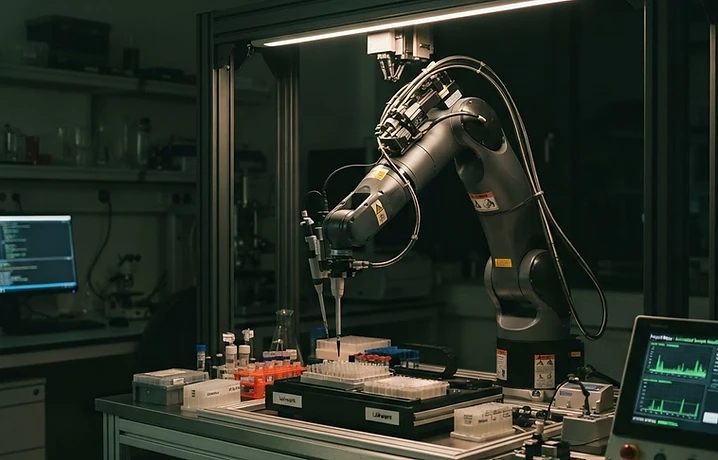
Project Maya is our programme to give a research lab a closed loop — the gantry moves the sample, the vision module reads the result, the edge controller decides the next step, and the data lands in a structured record the morning after. This update marks the first cell running unattended overnight cycles here in Munich.
The cell combines a graphite gantry frame, a precision multi-axis arm, and a vision module trained on the samples it actually sees in the lab rather than a clean bench dataset. In the first runs the system held a stable cycle time across a four-hour window with no operator intervention — a small result, but the one that matters: the loop stayed closed.
What comes next is the part we care about. With the loop closed on the hardware side, the work moves to the data: a structured record per run, a reproducible trail back to the raw sensor stream, and an interface a researcher can actually read. Maya is not a single robot — it is the body of automation around an experiment.